

Australians are willing to recycle and reduce waste — but outdated government systems, fragmented policies and poor infrastructure for waste management are holding the nation back.
Australia likes to see itself as a clean, modern and environmentally conscious nation, yet when it comes to waste management, the country is lagging badly behind many parts of Europe and Asia. While millions of Australians sort their bins, return containers and try to make sustainable choices, the larger systems designed to manage waste often fail them. The problem is not a lack of public effort — it is a lack of national coordination, investment and political urgency. Compared with world leaders in recycling and circular economy policy, Australia’s waste system remains fragmented, landfill-heavy and far too slow to modernise.
Australia’s waste challenge begins with scale. The nation generates some of the highest waste volumes per person in the developed world. Parliamentary reports have noted Australians produce around 2.7 tonnes of waste per person each year, with a significant portion still ending up in landfill. That figure reflects not only household rubbish, but construction, commercial and industrial waste as well.
Despite widespread public concern about the environment, much of Australia’s policy response has been reactive rather than strategic. Waste rules differ between states and territories, meaning residents in one part of the country may have access to better recycling systems than those in another. What can be recycled in Sydney may differ from Melbourne, Brisbane or Perth. This patchwork approach creates confusion for households and businesses alike.

Landfill Is Still Too Cheap
One of the biggest reasons Australia struggles to improve is that landfill often remains the cheapest option. In countries that lead on waste reduction — such as Germany, the Netherlands, Sweden and South Korea — governments have made landfill expensive and unattractive through taxes, bans or strict diversion targets. This forces investment into recycling, reuse, composting and waste-to-energy alternatives.
Australia has moved more slowly. In many regions, burying waste is still economically easier than recovering materials. When landfill is cheap, innovation suffers. Businesses have less incentive to redesign packaging, invest in recycling technology or use recovered materials.
A Circular Economy Laggard
The clearest sign of Australia’s underperformance is its circularity rate — a measure of how much material is reused, repaired or recycled back into the economy instead of discarded. According to the Australian Bureau of Statistics, Australia’s circularity rate was about 4.3% in 2024, below the global average of 6.9%. CSIRO previously reported it was roughly half the global average.
That means Australia extracts, consumes and disposes of materials at a rate that far outpaces its ability to reuse them.
By contrast, countries across Europe have spent years building repair systems, deposit schemes, recycled-content mandates and producer responsibility laws that keep materials circulating for longer.


The Recycling Illusion
Many Australians carefully rinse containers, flatten cardboard and separate recyclables, believing the system works efficiently. But too often, recycling is undermined by contamination, limited domestic processing capacity and weak end markets for recycled materials.
The collapse of major soft plastics programs exposed this problem dramatically. Two years after the REDcycle failure, reports showed around 94% of Australia’s soft plastics were still ending up in landfill, with only limited collection options returning.
This is where public frustration is justified. People are asked to do the right thing, but governments and industry have not always built the infrastructure to match that effort.
Plastic Waste Keeps Rising
Australia’s plastic waste problem is also worsening. Recent reporting based on government data found plastic waste rose to 3.2 million tonnes, while plastics recovery rates remained low. Packaging remains one of the largest contributors.
Other countries are moving faster by banning problematic single-use items, mandating refill systems or requiring minimum recycled content in packaging. Australia has discussed many of these reforms, but progress has often been slow, inconsistent or voluntary.
That delay matters. Every year of hesitation means more waste to landfill, more litter, and more lost economic value.
What Other Countries Do Better
Several nations offer clear lessons:
- Germany achieves very high container return rates through strong deposit schemes and convenient collection networks.
- South Korea has advanced food waste separation systems and charges based on waste generation.
- Sweden uses a mix of recycling, energy recovery and landfill minimisation.
- Japan has strict sorting rules and strong community participation backed by clear government systems.
Australia does have container deposit schemes now nationwide, but campaigners argue returns still trail top European performers, where higher deposits can push return rates above 90%.
The difference is not that Australians care less. It is that leading countries make sustainable behaviour easier, clearer and more rewarding.
Australians Are Trying
It is important not to blame the public. Across the country, households are embracing FOGO bins, container returns, second-hand shopping, reusable products and community clean-ups. Many councils and local organisations are doing meaningful work.
The issue is that citizens can only be as effective as the systems around them. If packaging is unrecyclable, if labels are misleading, if facilities are lacking, or if regulations are weak, household effort reaches a ceiling.
Australians are often willing participants in sustainability — but they need governments to match that commitment.

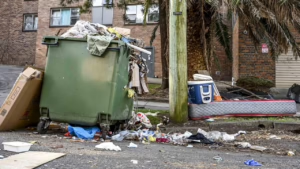
Photo from The Guardian
What Needs to Change
If Australia wants to catch up, experts regularly point to several priorities:
- Harmonise recycling rules nationally
- Make landfill less financially attractive
- Invest in domestic recycling and remanufacturing
- Introduce stronger producer responsibility laws
- Mandate recycled content in packaging
- Expand repair, reuse and refill systems
- Improve consumer labelling and transparency
These are not radical ideas. They are already standard practice in many countries outperforming Australia.
The Bottom Line
Australia’s waste management problem is not caused by lazy households or indifferent communities. It is largely the result of policy fragmentation, underinvestment and a system that still rewards disposal over recovery.
Australians are trying. The bins are sorted. The bottles are returned. The concern is real.
Now the country needs leadership bold enough to build a waste system worthy of that public effort.
